BJJ Mats for Academies: Roll-Out vs Interlocking Mats and Space Planning
For BJJ academies, the choice between roll-out and interlocking mats depends on floor layout, installation needs, seam count, storage requirements, and training style. fewer seams mean less bunching and faster daily setup or breakdown. Interlocking tiles make more sense for a permanent, dedicated mat room where you never need to move the floor and want to cut mats around pillars or odd corners. The real decision isn’t just mat type though — it’s matching that choice to your class schedule, room shape, and how many mats you’ll need to buy in bulk.
Why Seams Matter More Than Most Buyers Think
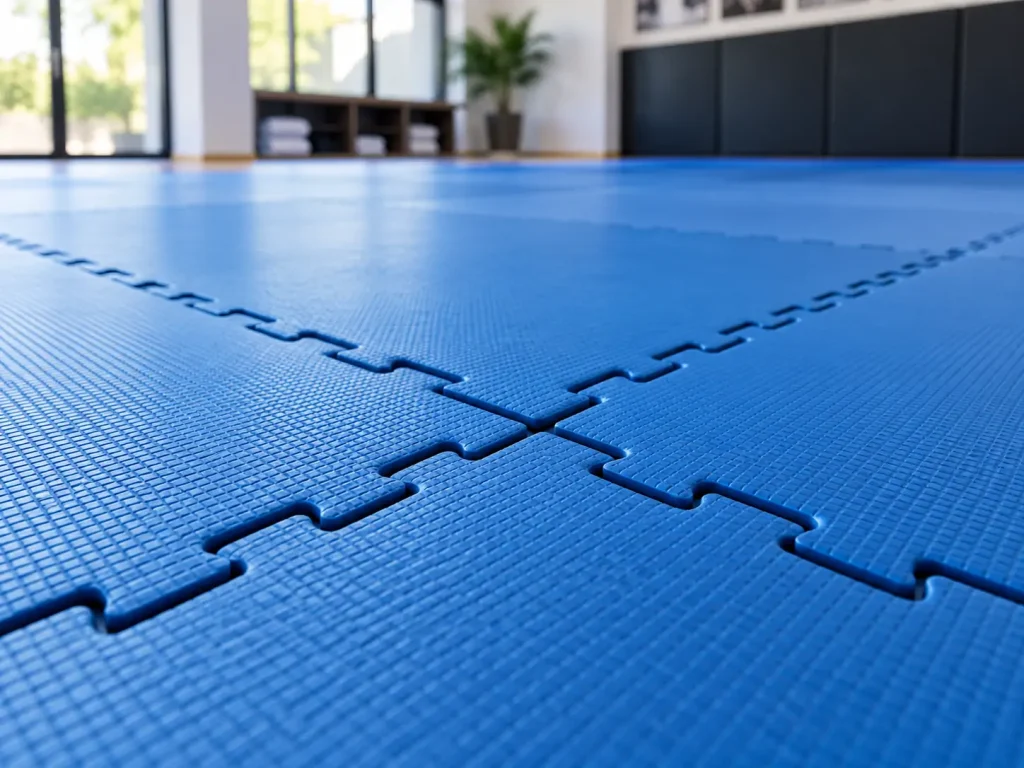
Here’s a mistake a lot of new academy owners make: they buy the cheapest tiles available without thinking about how many seams end up on the floor. Every seam is a place where a mat can shift during a scramble, where dirt and sweat collect, and where a toe can catch during a takedown.
Roll-out mats are produced in long sections, with width and length varying by manufacturer and project requirements. might only need 4-6 rolls to cover a 1,500 sq ft training floor — meaning just a handful of seams total. Interlocking puzzle mats covering the same space could involve 150+ individual tiles and hundreds of linear feet of seam lines.
When Seams Actually Cause Problems
For no-gi rolling especially, sweat works into seams fast. Poorly fitted or low-density interlocking mats may develop gaps or movement under repeated heavy use, especially if the floor is not properly contained or installed. For high-traffic academies, seam count should be considered alongside foam construction, thickness, surface grip, and installation stability.
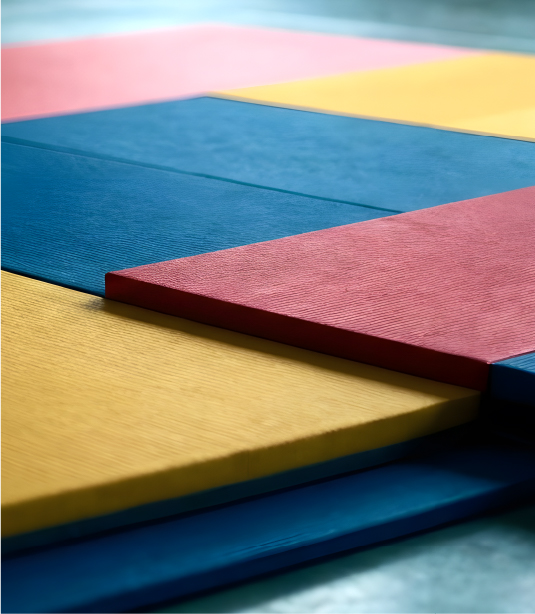
Close-up of interlocking mat tile seams on a gym floor
Thickness: Don’t Copy What Your Competitor’s Gym Uses
BJJ doesn’t need the same thickness as gymnastics landing or crash mats. Thickness should be matched with foam density and compression characteristics, because a thicker mat is not automatically better if the surface becomes too soft or unstable underfoot. Commercial BJJ academies commonly use mat systems around 1.25–2 inches (approximately 32–50 mm), depending on foam density, construction, subfloor conditions, and training intensity.
Thickness alone does not determine how a BJJ mat will perform. Foam type, density, and compression resistance all affect how firm the floor feels and how it responds under repeated takedowns. Two mats with the same thickness can therefore feel very different in daily training.
For comparison context on impact-focused surfaces, our tatami vs. smooth surface judo mat breakdown covers surface texture tradeoffs that apply directly to BJJ academies running mixed gi/no-gi curriculum.
Roll-Out Mats: Best for Rotating or Shared Spaces
If your academy shares a building with other programs — say a fitness studio that needs open floor at 6am and BJJ at 6pm — roll-out mats are the only realistic option. Roll-out sections can generally be installed and removed faster than assembling a large floor from individual tiles and have the floor cleared just as fast.
For example, a startup academy renting space in a strip mall unit often can’t justify a permanent mat installation on someone else’s lease. Roll-out mats let them run a full 90-minute class, then break down completely so the landlord’s other tenant can use the space for yoga or CrossFit that evening.
The Storage Tradeoff
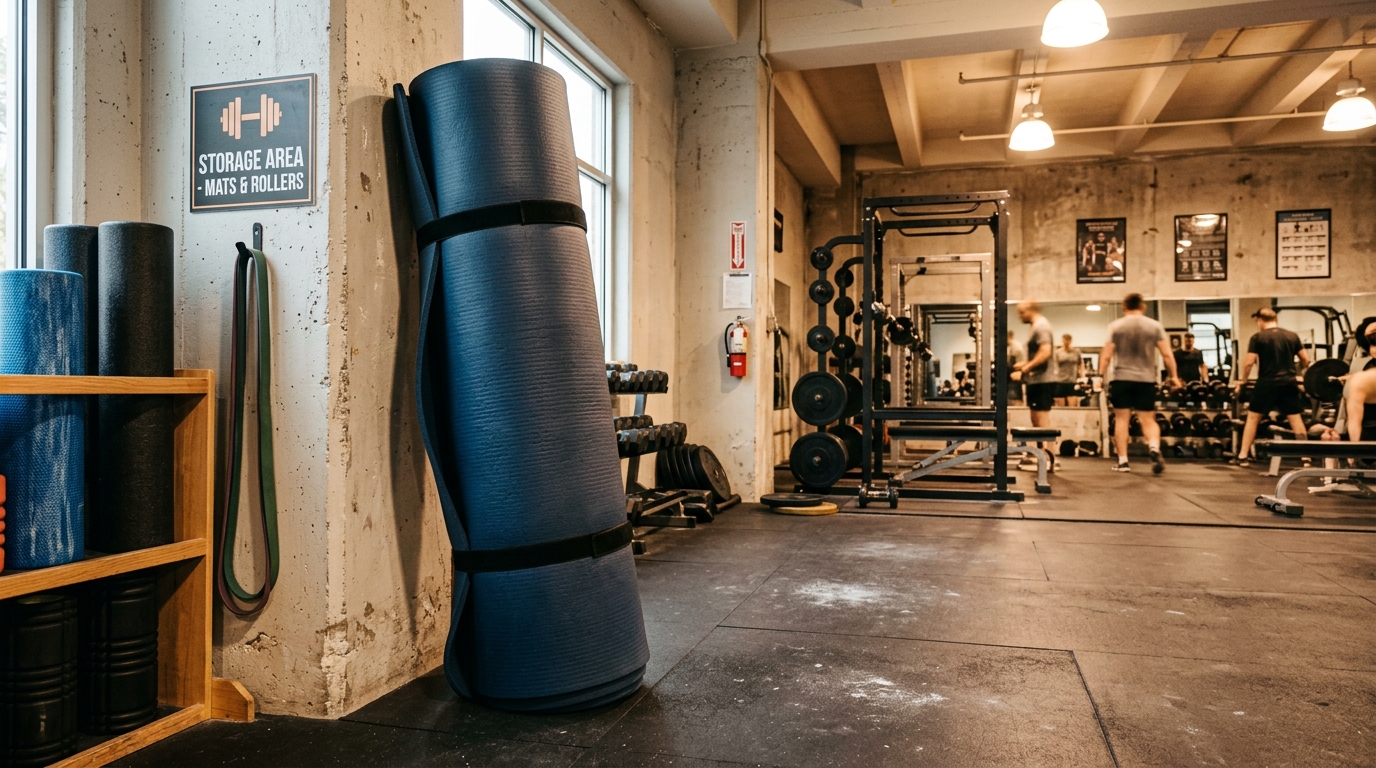
The catch: rolled mats need somewhere to live. A 30ft roll takes real wall space standing upright, or floor space lying flat. Academies underestimate this constantly and end up with rolled mats blocking hallways.
Rolled foam training mat standing against gym wall
Interlocking Tiles: Best for Permanent Dedicated Rooms
If you own your building or have a long-term lease on a dedicated mat room, interlocking tiles usually win on long-term value. No daily setup labor, no storage headache, and you can build around structural columns or angled walls that a single roll-out sheet can’t handle cleanly.
Rooms with multiple columns, angled walls, or irregular edges may be easier to finish with modular interlocking mats because individual sections can be trimmed independently. — you’d need custom cutting on an expensive continuous roll. With interlocking tiles, you simply leave out or trim the tiles around the column and move on.
Tiles also make partial replacement realistic. If one corner near the door takes heavy foot traffic and wears out, you replace 20 tiles instead of an entire 30ft roll.
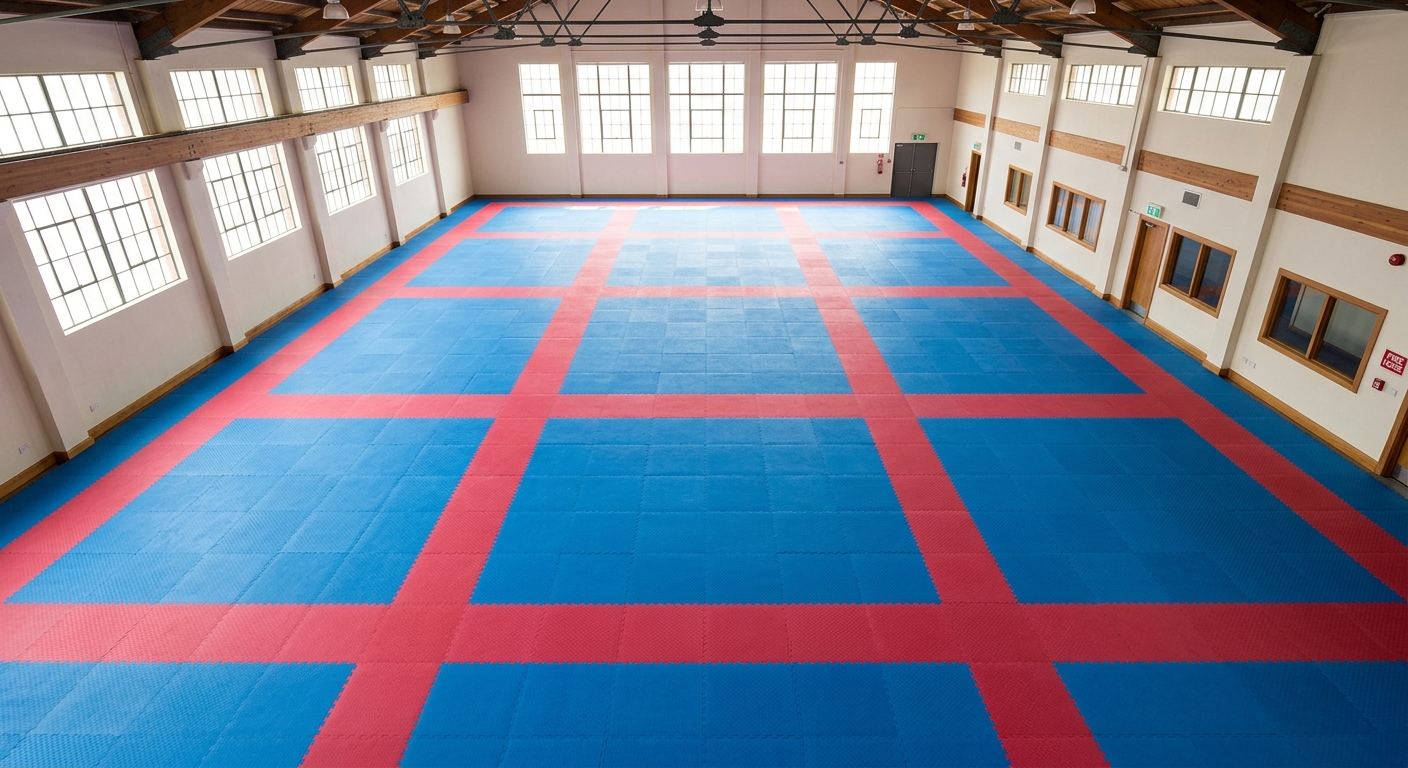
Overhead view of interlocking tile flooring in a training room
Space Planning: How Many Mats Do You Actually Need?
As a practical planning estimate, many academies allow additional mat area per student based on class format, drilling intensity, and takedown frequency. training at once, more for judo/wrestling-heavy programs with throws. A class of 20 students rolling simultaneously needs roughly 600-700 sq ft of clear mat space, not counting the buffer zone around the walls.
The Wall Buffer Nobody Budgets For
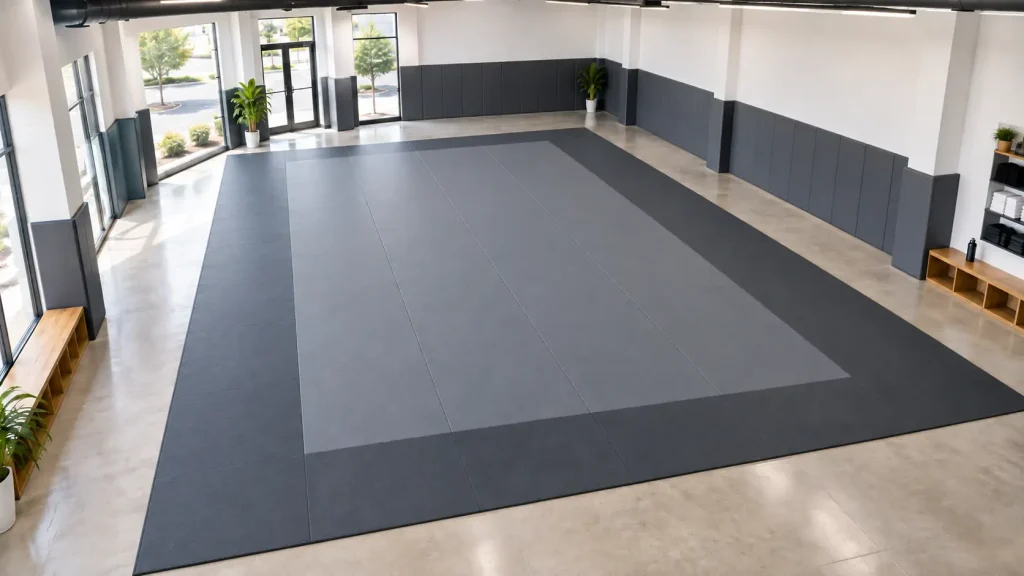
Allow additional clearance or padded protection around hard walls, columns, and other fixed obstacles. The required buffer depends on the training format and room layout. Academies that skip this end up needing gym wall padding retrofitted later after someone gets slammed into drywall during a scramble — an avoidable cost if it’s planned from day one.
Also factor in dead space: mat storage corners, first-aid stations, and instructor observation lanes all eat into your usable rolling footprint. Measure your actual clear floor, not the room’s total square footage.
Empty martial arts gym floor plan with matted area and wall padding
Cost Per Square Foot Isn’t the Whole Story
Interlocking tiles often look cheaper on a per-square-foot quote, but labor to install hundreds of tiles adds real hours — either your staff’s time or a contractor’s invoice. Roll-out mats cost more per unit but install in a fraction of the time with fewer workers.
Price per square foot is useful for an initial comparison, but it does not represent the full cost of a BJJ flooring project. Final cost can vary with mat thickness, foam density, room dimensions, freight, connection materials, perimeter finishing, subfloor preparation, and any cutting required on site.
Installation time also depends heavily on the room itself. A large rectangular training area is usually quicker to complete than a space with columns, recesses, angled walls, or extensive edge trimming. Roll-out mats reduce the number of individual sections that need to be positioned, while interlocking mats can make fitting irregular areas more flexible. For academy owners, comparing the complete installation plan is more useful than relying on a fixed labor-hour estimate.
Custom Sizing, Logos, and Bulk Ordering for Multi-Location Academies
Academies expanding to a second or third location shouldn’t reorder mats from scratch each time — standardizing on one supplier for custom-cut sizing and consistent branding saves both money and headaches. Logo-embossed center mats or branded color zones (competition circle, warm-up strip) are common requests from growing academy chains.
Crosstemat works directly with gym owners and distributors on OEM/ODM manufacturing for exactly this — matching thickness, color, and logo placement across multiple locations so every branch has a consistent look and feel. Volume pricing may be available depending on total mat area, specifications, and shipment quantity.
Browse the full sports mat product range to compare thickness and material options side by side before requesting a quote.
Maintenance Realities: What Actually Wears Out First
Regardless of mat type, the wear pattern is predictable: the center circle where most rolling happens degrades first, and the edges near the door take the most foot traffic and grit. Interlocking tiles let you rotate or flip individual pieces to even out wear — a trick most roll-out mat owners can’t use since the whole sheet wears as one unit.
High-frequency training, repeated cleaning, abrasive dirt, and improper cleaning chemicals can gradually affect surface texture and grip performance. If your academy runs mostly no-gi, budget for surface replacement or resurfacing sooner than a gi-focused school would need.

 Home Use Roll Up Wrestling Mat for Training and Practice