Judo Gi Fabric Guide: GSM, Sashiko Weave, Shrinkage and OEM Size Grading
Choosing fabric for a judo gi is mainly about how the jacket handles gripping, repeated washing, and post-wash fit. For clubs, distributors, and private-label buyers, the most important checks are fabric weight, Sashiko weave, shrinkage control, and consistent OEM sizing. This guide explains the practical specifications to confirm before approving a judo gi sample or bulk order.
For products intended for official IJF competitions, buyers should distinguish general OEM specifications from official IJF approval or certification. Meeting selected construction targets alone does not make a judogi IJF-approved or certified.
GSM: Choose the Right Judo Gi Fabric Weight
GSM means grams per square meter and indicates the weight of the fabric. A higher GSM generally creates a denser, more structured jacket, but it can also add shipping weight and take longer to dry. The heaviest fabric is not automatically the best choice for every judo program.
When comparing judo gi fabrics, consider the athlete’s age, training frequency, expected grip stress, target price, and care routine. A supplier should be able to recommend a suitable fabric weight for the intended use instead of offering one standard option for every order.
For OEM production, confirm whether the quoted GSM refers to the unfinished fabric or the finished fabric. The fabric sample, hand feel, and final garment measurements should all be checked before bulk production.
For judogi intended for official IJF competitions, the March 2026 IJF Judogi Manufacturing Regulations specify that fabric weight is assessed after a new, unused jacket has been washed and dried. The specified range is 650–750 g/m², with a ±5% tolerance. Use these figures as a technical reference only; they do not indicate IJF approval or certification unless the product has completed the official certification process.
Why GSM Should Not Be Checked Alone
Two fabrics with a similar GSM can feel and perform differently because of yarn quality, weave density, finishing, and sewing construction. For that reason, buyers should compare the physical sample together with the fabric specification rather than approving an order from the GSM number alone.
Collar construction, reinforcement placement, and post-wash fabric behavior should also be reviewed because they can change grip feel and durability even when two jackets have a similar GSM.
Cotton and Cotton-Blend Judo Gis
100% cotton provides a traditional feel and absorbs moisture well, but it needs effective shrinkage control and may take longer to dry. Cotton-blend fabrics can dry faster and maintain their dimensions more easily, although the hand feel may differ from a traditional cotton judo gi.
Choose the fabric according to the training environment, customer expectations, washing routine, and target price. The final composition, fabric weight, color, and care instructions should be written into the approved specification sheet.
For judogi intended for official IJF competitions, the manufacturing regulation requires cotton or a cotton blend containing more than 70% cotton. Non-cotton components must remain below 30% and may include fibres such as rayon, nylon, or polyester. This is a manufacturing reference only and should not be presented as proof of IJF certification.
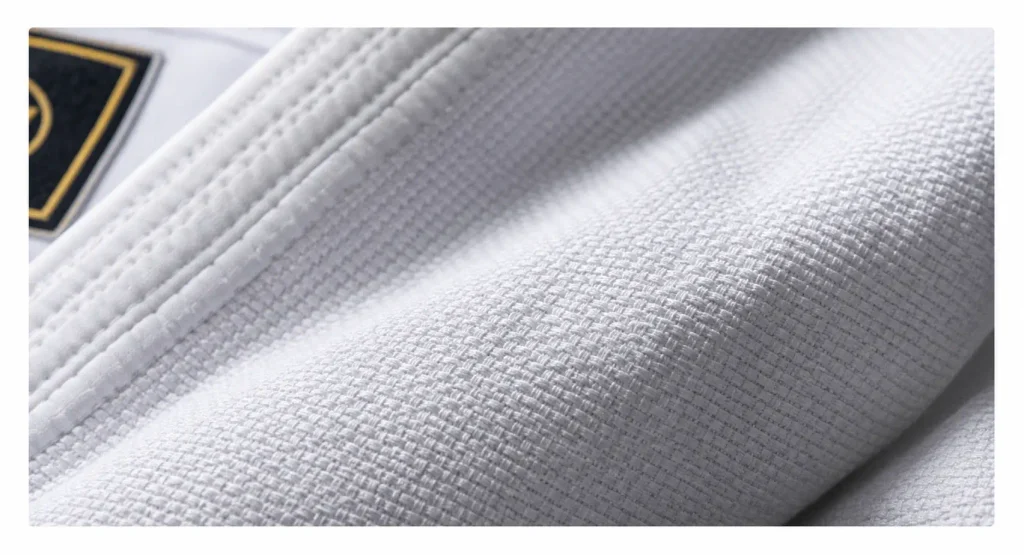
Close-up of Sashiko judo gi fabric showing its woven surface
Sashiko Weave and Jacket Fabric Construction
Sashiko weave is a textured fabric construction commonly used for the upper part of a judo gi jacket. Its raised rice-grain surface and firm hand feel help provide the structure required for repeated gripping and pulling during training.
However, the word “Sashiko” alone does not guarantee a durable judo gi. Yarn quality, weave density, fabric weight, collar construction, and reinforcement at stress points all affect the finished product. Ask the supplier to provide a fabric swatch and a complete construction specification with the OEM sample.
A judo jacket should not be treated as one uniform Sashiko fabric from top to bottom. Under the March 2026 IJF manufacturing regulation, the upper jacket is made with Sashiko, or “rice grain,” fabric. The lower jacket uses a light, strong plain- or twill-weave fabric combined with diamond-patterned Sashiko. The trousers and jacket collar use twill fabric.
Double Sashiko, Strength and Stitch Density
For judogi intended for official IJF competitions, the March 2026 IJF manufacturing regulation specifies double Sashiko for the upper jacket, which must withstand a tensile force of 2,200 N, and 3–5 Sashiko stitches per inch after washing and drying. These figures are technical references and do not by themselves indicate IJF approval or certification.
Sashiko Direction Also Matters
The Sashiko yarn should run horizontally when the jacket is worn. The IJF regulation states that horizontal yarns reinforce the fabric against horizontal tension, while vertical yarns can make the fabric slippery and reduce grip.
What to Check in a Sashiko Sample
Compare the surface texture, flexibility, stitching, collar firmness, and overall hand feel. A suitable judo gi should feel structured without making movement unnecessarily difficult. The same fabric and sewing details should then be used consistently across the approved production batch.
For a more complete inspection, also record the upper- and lower-jacket fabric construction, Sashiko direction, stitch density, and any agreed strength-test requirement on the sample approval sheet.
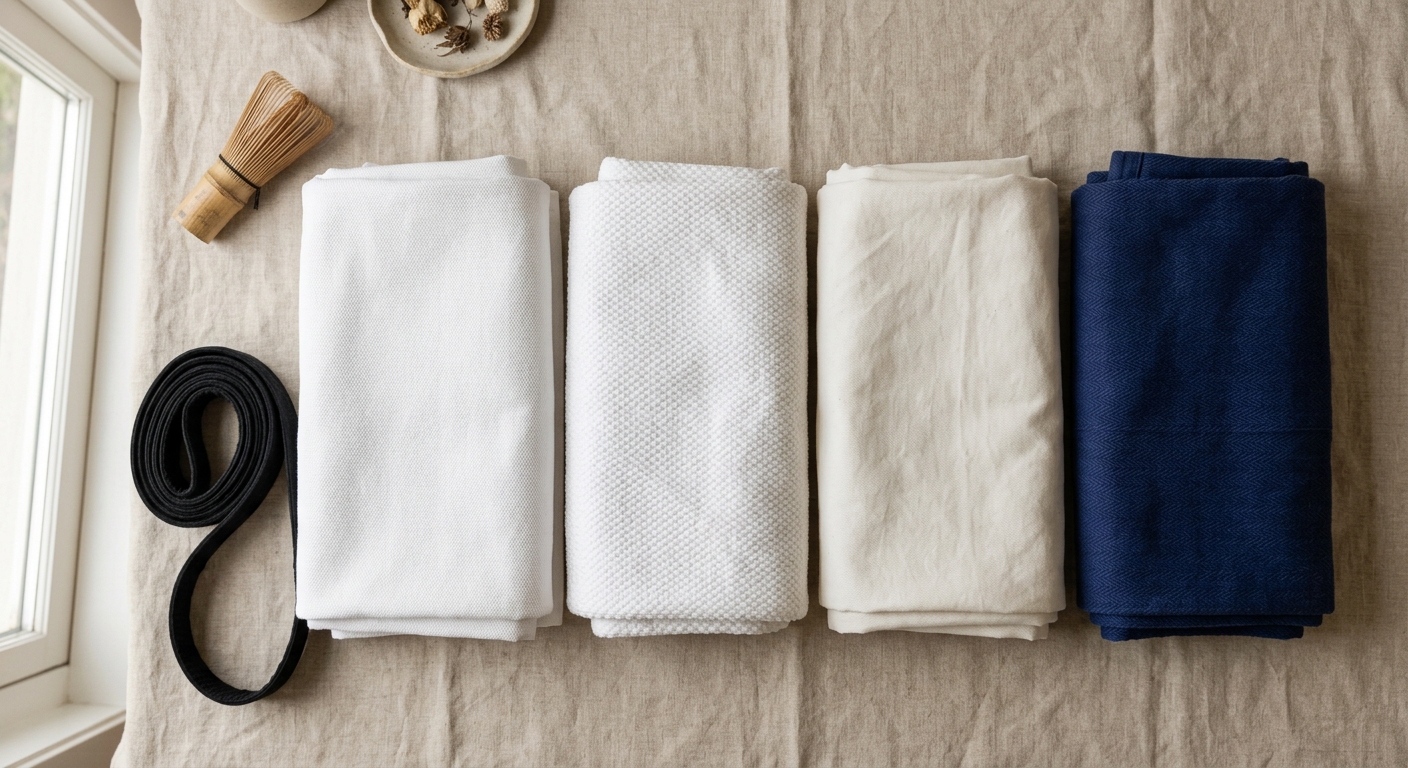
Folded judo gi fabric samples showing different weave textures
Collar Construction and Grip Resistance
The collar should be evaluated separately from the jacket GSM because collar width, thickness, internal material, and stitching affect both gripping and overall rigidity. A heavy jacket with an excessively hard collar can still perform poorly in use.
For judogi intended for official IJF competitions, the March 2026 IJF manufacturing regulation specifies a 4 cm collar width, a maximum collar thickness of 1 cm, and four rows of stitching. It also includes a collar-hardness check after washing and drying. For OEM orders outside the IJF certification system, the buyer and supplier should define the collar width, thickness, firmness, and internal construction in the approved specification.
Shrinkage: Confirm the Post-Wash Fit
Uncontrolled cotton shrinkage can shorten the sleeves and jacket, reduce trouser length, and change the fit after the first few washes. This is why the size chart should not be approved before the fabric has been tested under the expected care conditions.
Pre-shrunk or pre-washed fabric can help control size changes, but the result still depends on the fiber content, finishing process, washing temperature, drying method, and garment construction. The supplier should state the expected shrinkage behavior and explain how it was tested.
Pre-shrinking reduces dimensional change; it should not be interpreted as zero shrinkage.
Use a Wash Test Before Bulk Production
Measure the jacket and trousers before and after washing the approved sample. Record the wash method, drying method, and key garment measurements so the result can be compared with the production specification. If the post-wash fit is not acceptable, adjust the fabric treatment or pattern before cutting the bulk order.
A simple calculation can be used for each measurement: Shrinkage (%) = [(measurement before washing − measurement after washing) / measurement before washing] × 100. Record results separately for jacket length, sleeve span, chest width, trouser length, inseam, and waist.
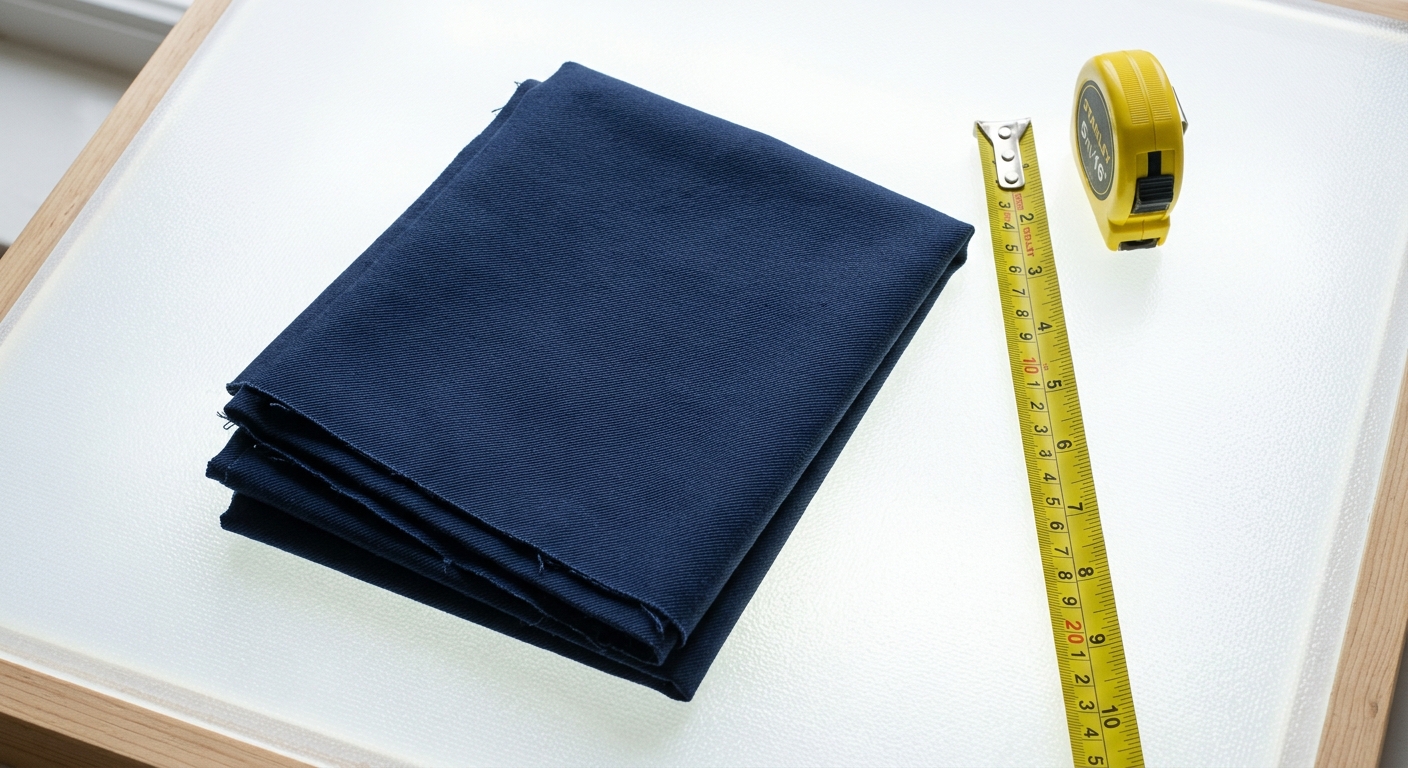
Judo gi fabric sample being measured before and after a shrinkage test
OEM Size Grading: Keep Every Judo Gi Consistent
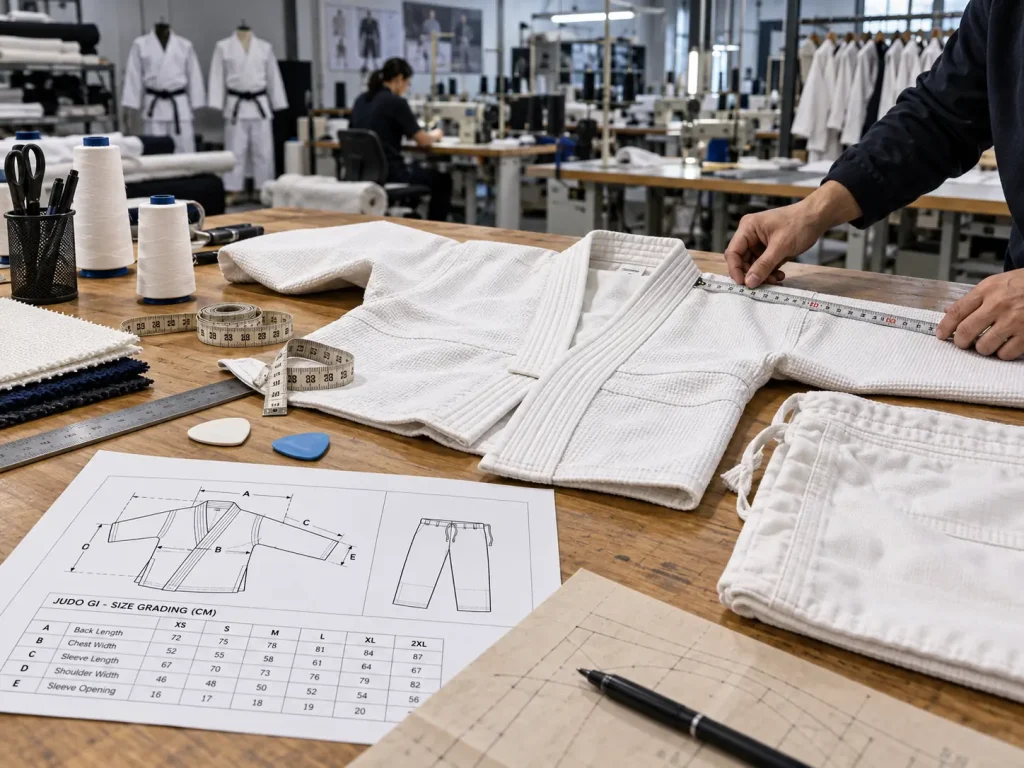
Judo gi sizing is usually based on height and body build, but the label alone does not define the fit. A reliable OEM size chart should include finished measurements for the jacket, sleeves, trousers, and waist, together with the allowable tolerance for each measurement.
Grade Rules and Tolerance
A fixed grade rule helps keep the proportions consistent as the size changes. Request the full measurement sheet and check the approved sample against it before production. The factory should also explain how measurements are taken, especially for sleeve length, jacket length, trouser inseam, and waist width.
For judo-specific grading, add measurement points such as sleeve-to-sleeve span, half chest, sleeve opening, collar width, jacket side-slit length, trouser outseam, inseam, rise, hip, waist, and leg opening. Define the measurement method and tolerance for each point so different inspectors obtain comparable results.
Custom Grading for Clubs and Private Labels
Clubs and brands may need a different fit for children, junior athletes, or a specific customer group. These adjustments can be incorporated into an OEM and ODM manufacturing program by changing grade rules, body length, sleeve proportion, or trouser shape before the grading rules and production pattern are finalized.
Technical size grading chart and measuring tools on a manufacturing workbench
Reinforcement: Define the Stress Points
Do not approve a judo gi only from fabric and sizing data. Reinforcement construction should be written into the specification because repeated pulling concentrates stress at the shoulders, chest, armpits, sleeve cuffs, side slits, trouser knees, and crotch area.
For higher-specification samples, inspect reinforcement size, material, layer count, stitch rows, seam quality, and symmetry. The March 2026 IJF manufacturing regulation addresses shoulder, chest, and armpit reinforcements, as well as trouser knee and crotch construction. These provisions may be used as technical reference points, but they do not by themselves indicate IJF approval or certification.
Judo Gi OEM Approval Checklist
Before approving a bulk production run, confirm the following points:
Fabric composition, finished GSM, and Sashiko weave construction are documented
For competition-oriented specifications, the agreed reference range and test method are clearly stated
Upper- and lower-jacket fabric constructions, Sashiko direction, and collar construction match the approved sample
The collar, cuffs, shoulders, chest, armpits, side slits, trouser knees, seams, and other agreed stress points are reinforced as specified
The approved sample has been washed and measured for shrinkage
Every size has finished garment measurements, grade rules, measurement methods, and defined tolerances
Color, embroidery, labels, and packaging match the approved sample
A physical pre-production sample and the final specification sheet are both approved before bulk cutting begins
A physical pre-production sample is the most reliable way to confirm fabric feel, fit, construction, and post-wash performance. Once the sample and specification sheet are approved, the factory can use them as the reference for the full judo gi order.
Before Requesting a Judo Gi Quote
A successful OEM judo gi program connects fabric weight, fiber composition, Sashiko construction, collar design, shrinkage control, reinforcement, and size grading. Reviewing these items together gives buyers a clearer basis for comparing suppliers and reduces the risk of fabric or sizing problems appearing after delivery.
When requesting a quote, send the target fabric feel, intended use, preferred GSM, fiber composition, size range, size chart, logo requirements, quantity, color, packaging, and expected care conditions. For custom judo gi development, see Judo uniforms for clubs and wholesale supply and OEM and ODM manufacturing services. If the product is intended for formal competition, also state the exact governing standard or certification requirement so the supplier can distinguish general competition-oriented construction from officially approved equipment.

 Home Use Roll Up Wrestling Mat for Training and Practice